Physics with a side of philosophy
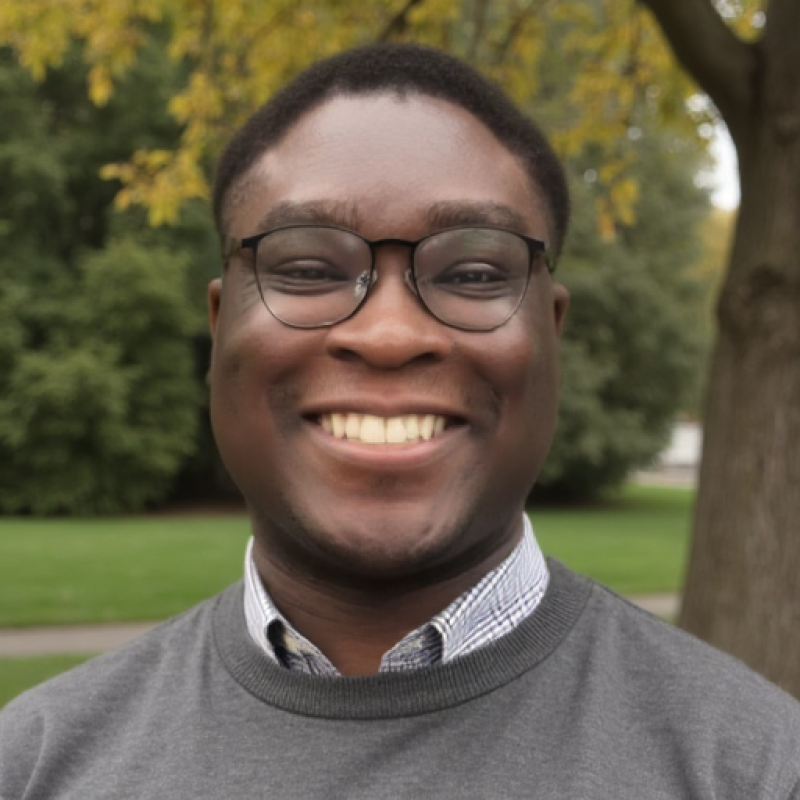
I'm Bolaji Eniwaye. Currently I work on the markets research team at BlackRock. Prior to this I studied applied physics at the University of Michigan. I spend a lot of time thinking about ethics, perception, and the way networks (social, financial, computational) shape what happens next.
Background
Bio
I'm a physicist who now works in Finance (it's more common than you think). I also spend a lot of time thinking about philosophy, especially ethics, perception, and the "why" behind the choices societies make.
What I do
"All models are wrong, but some are useful." I'm currently on the markets research team trying to use my background to better understand the market and the society that it underlies. I mostly deal with distilling signals from the market to improve trading decisions, but I also spend a lot of time thinking about the broader implications of how financial systems shape incentives and outcomes.
What I care about
Beyond work, I'm into the philosophy of mind. How does consciousness emerge from the interaction of simple biological components? And what similarities does this have with the emergent properties of society, including culture and conflicts.
Essays
Recent Thoughts
Voting, justice, and the logic of participation
Imagine a small minority could pass a law that labels 90% of people in a society as "criminal" (for example, "right-hand people are criminals and shall be incarcerated immediately"). In our current society, this would mean 90% of people wouldn't be allowed to vote. The confiscation of voting rights of the incarcerated are one of the many ways that practices in the criminal justice system solidify inequality in our society.
Banning prisoners from voting cuts off the mechanism people, the majority even, could use to change the system that defines them as "criminal."
I feel reasonably strongly that prisoners should have the right to vote. But is there a reasonable argument to the contrary? If this extended to firearms would it still be reasonable? Should violent criminals have access to weapons capable of widespread harm? Feel free to reach out if you have thoughts on this.
Consciousness and Plato's cave
The Allegory of the Cave resonates with me because it treats "reality" as something we experience through a structured interpretation. In the cave, the shadows aren't random, they come from something behind them.
In that same spirit, our senses can be seen as an interface: what reaches consciousness isn't the world "as it is," but an imprint the world leaves on our perceptual system. If we had the biology of migratory birds we would effectively be able to see the magnetic fields. The Maxwell equations may have basically been self-evident to us. Since experience depends both on what our antennae can pick up and on how our cognitive machinery translates this into meaning, it may be (or almost certainly is) the case that there are worlds of phenomena that we'll never codify because there are places that scientists will never think to look.
Perhaps mathematics can bridge this gap. How many times have seemingly purely theoretical mathematical discoveries turned out to be the key to understanding physical phenomena? But even if this were the case, it still presents an unreachable frontier. The proof to Fermat's last theorem was over 100 pages and is not the largest proof by far. If there was a proof that was 1 million pages long, then it could take the most talented mathematician most if not all of their lives to understand it. The truth of the world will likely be forever beyond the reach of our understanding, much like the ever-fleeting boundary of the observable universe.
Why the simulation question may be beside the point
Simulations don't have to be in silico, architects and civil engineers make simulations all the time with physical substrates. Atoms were once modeled by billiard balls before more complex models came along. The question of whether we are simulated, exacerbated by the debut of the matrix and even more so by the advent of LLMs, may not be as consequential as it seems.
Whether we are produced in silico or have physical substrate, we are still atomic interactions projected on a canvas that can't fully capture the complexity of the world. A subset of reality interacting with a subset of the information reality contains.
Lists
Favorites
Favorite movies (Top 21)
- Bones and All — A tragic love story, think macabre twilight. One of Chalamet's breakout roles.
- Pulp Fiction — You've heard of it already. Worth the watch.
- Black Swan — Basically about the price of perfectionism.
- Grave of the Fireflies — Even if you're not into anime this is something you should watch. More of an animated war film.
- La vita e bella — This move made me cry in 8th grade and again while drunk at a diner in college. Holocaust + optimism + tragedy.
- The Deer Hunter — Another war film. Vietnam war, Robert De Niro. Delves into PTSD and addiction.
- The Prestige — One of the movies that got me thinking about consciousness and perception. Think Houdini + Ship of Theseus.
- The Shining — "Heres Johnny", but it's actually really good. All of stephen king's books are connected, this movie feeds into the show It: Welcome to Derry.
- Prometheus — My favorite "Alien" film. Reasonably existential.
- Sinners — Jim Crow Era + Vampires.
- Reservoir Dogs — One of the best bank heist/murder mystery movies.
- A Clockwork Orange — This movie is pretty explicit so read about it before you watch. But it leaves you to think about the ethics of rehabilitation, and the cost of improving society.
- Scarface — An immigrant's climb from desperation to power becomes a spiral of violence and paranoia.
- Black Panther — Wakanda Forever. The best marvel movie in my opinion.
- The Fly — Kind of like a spider-man origin story gone wrong. The cost of scientific ambition.
- Pearl — A fragile young woman's fixation on fantasy curdles into obsession and cruelty.
- Nope — An original take on alien invasion.
- Midsommar — A couple is pulled into a sunlit cult that offers relief and then demands payment in blood.
- Hunter x Hunter (series) — Favorite anime of all time. Got me thinking a lot about risk and reward in life.
- Wall Street (1984) — "It's not a question of enough, pal. It's a zero-sum game, somebody wins, somebody loses. Money itself isn't lost or made, it's simply transferred from one perception to another."
- Doctor Sleep — Direct sequel to the shining.
Artists I like
Some artists I like:
- Lana Del Rey
- The Weeknd
- Queen
- Glass Animals
- Polo G
- Tyler, The Creator
- Alessia Cara
- Lorde
- Miley Cyrus
- Rihanna
Curiosities
Research Interests
A big part of what I'm curious about is how "information" turns into experience and behavior: inside the brain, inside groups, and inside systems we build.
Neuroscience
I'm fascinated by how the brain turns sensory input into a coherent world: not just "seeing things," but building stable models of what's out there, and updating them when the model fails.
Social dynamics
People don't just react to facts; they react to incentives, stories, and each other. Social networks can amplify misunderstandings, or accelerate learning, so I like thinking about how small changes propagate into big outcomes.
Cryptography
Cryptography, a relatively recent interest. Asymetric encryption/trapdoor functions/public-private keys feel like magic. Information preferentially flows one way, how crazy is that.
Financial networks
Finance is a network of obligations and feedback. A small shock can travel in surprising ways, sometimes getting diluted, sometimes concentrating, and cascade to shape the world.
How it all connects
At the end of the day, I'm drawn to the theme of representation. In the brain, it's representation of the world. In societies, it's representation of meaning and incentives. In cryptography, it's representation of what can be proven. In financial systems, it's representation of risk and dependency. Different domains, same underlying question: how do complex processes generate coherent behavior?
Get in touch
Contact
Reach out anytime.